The Rose Island Story
About the Book
The Shadows We Chase
We often prefer a tragic story over a complex truth. It's easier to imagine Rose Island as a small, lonely place swallowed by a river, and its founder as a man who died broke and alone in a rented room. It gives the ruins a certain poetic sadness.
But Rose Island, Indiana wasn't a small summer memory, and David Rose wasn't a tragic failure.
To ignore the documented truth... that he lived a life of prestige alongside his wife and partner of fifty years, Esther Rose, is to ignore the real heartbeat of the place. It ignores the fact that Rose Island was an incredible destination that still, nearly a century later, pulls at the curiosity of anyone who walks its paths.
When I started this journey, I was chasing a myth. Lore. What I found instead was a community. I found stories of a husband and wife who built a legacy so massive it couldn't actually be washed away, it was just waiting for someone to stop telling the easy, poetic version of the story and start looking for the real one their legacy deserves.
To truly understand what Rose Island, Indiana meant to the hundreds of thousands who visited, is to understand the power of a dream that refuses to stay buried on a peninsula and the bottom of a riverbed.
The book is the journey of finding them again.
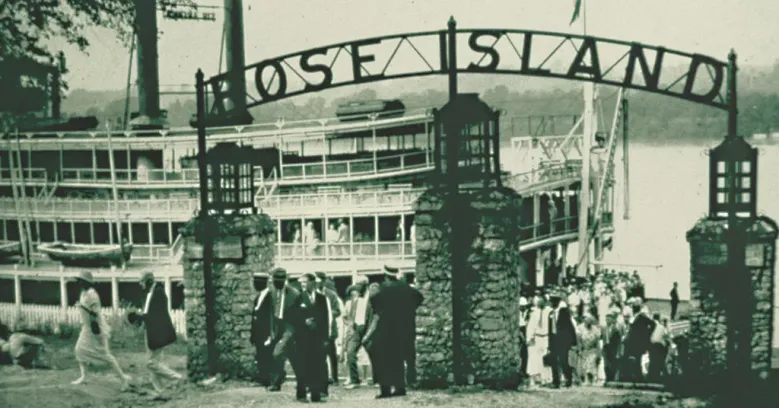
Contemporary reporting and later journalism routinely described it as "the Disneyland of its day," a regional destination offering excursion steamers, a grand hotel, rental cottages, a dance hall, a 1600-seat food hall, picnic grounds, a Ferris wheel, a roller coaster, and a filtered swimming pool considered a modern marvel when it opened in 1924.
During the peak of its annual season, from late May through August, as many as 4,000 people a day made the journey. Yet when the river reclaimed the peninsula in 1937, the park's story collapsed and slipped into folklore.
This book reconstructs Rose Island's story; the years before, during, and after its 14-year existence.
Framed by a present-day visit to the ruins, the narrative moves between past and present, drawing on census records, photographs, newspaper archives, legal deeds, letters, journals, oral histories, and family artifacts. Where the historical record holds, it guides the story. Where it falls silent, carefully constructed scenes and dialogue bridge the gaps without altering the facts.
The Novel Unfolds Across Three Intersecting Worlds
The Modern Ruins
A rain-soaked walk through moss-covered foundations and scattered stonework becomes an investigation into what survived the flood, what was lost, and what history failed to preserve.
The Years Before the Flood
Rose Island's heyday is reconstructed through the lives of those who built it, worked its rides, and believed in its promise: Tyler, an apprentice chocolatier who carries a bracelet of silver charms like a guarded secret; Juanita, a classically trained pianist with a yellow scarf whose future is as bright as the White Way lights; a maintenance man and his wife whose future begins in a small-town general store; Rose Sullivan, an actress navigating ambition and reinvention; and a founder whose flair for spectacle was matched by unyielding business discipline.
A Community Facing Catastrophe
As economic pressure from the Great Depression and the forced modernization of public entertainment mount, the river rises. The flood that destroyed Rose Island alters lives in a single hour and sets in motion decades of silence, distortion, and mythmaking.
"The Rose Island Story is not a nostalgic portrait of a lost amusement park. It is an examination of how legacies are simplified for convenience, how myths replace records, and what it costs when no one remains to challenge the version that survives."
A Note on Sources
This book is a work of historical reconstruction. While some scenes and dialogue are created to bridge gaps in the record, all major details are grounded in primary sources, including 1900–1940 census records documenting sustained success, property deeds for the 118-acre site, news photography, contemporaneous newspaper accounts, correspondence, journals, oral histories, and family-held artifacts.
Special thanks to Charlestown State Park and the Clark County Historical Society for their ongoing preservation of the region's history.
Where the facts ended, the story listened. Where they held firm, it let them speak.
Setting
Southern Indiana and the Ohio River region, 1913–1937, with a present-day frame
Themes
Legacy and memory | Myth versus record | Redemption and resilience | Family and belonging | The responsibility of preservation