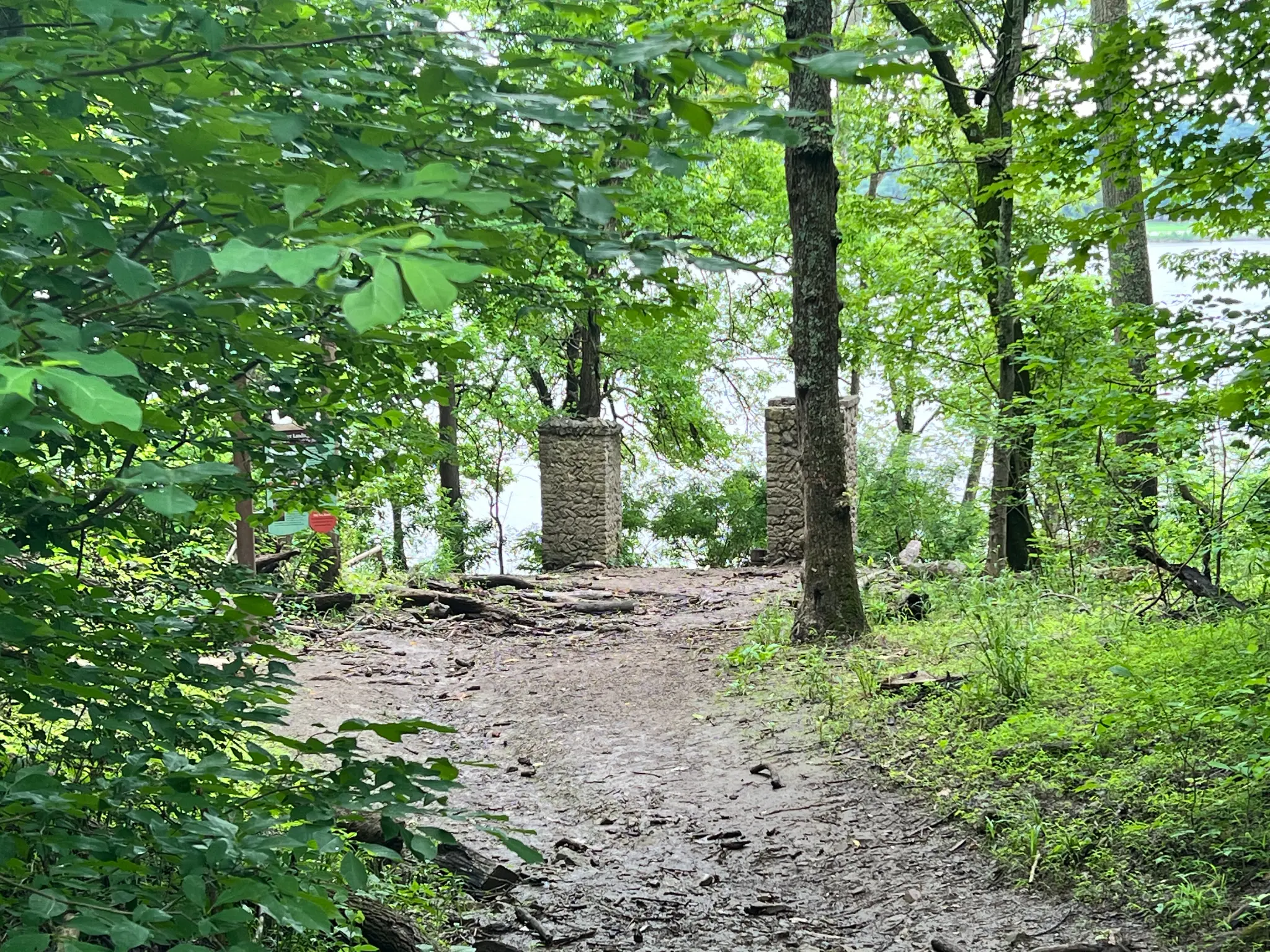
Rose Island Amusement Resort was a 118-acre amusement park and summer resort that operated from 1923 to 1937 on a peninsula along the Ohio River near Charlestown, Indiana. Today, its ruins sit within Charlestown State Park, accessible by a hiking trail that takes visitors through visible history: crumbling arches, a gravel-filled swimming pool with its original ladders still attached, and markers showing where ten feet of floodwater ended everything in January 1937.
The swimming pool ladders are what stay with you. Rusted now, curving up from the gravel that replaced the water decades ago, but unmistakably ladders. The kind generations of kids gripped before launching themselves into what was reportedly the first filtered swimming pool in the Midwest. Stand beside them on a quiet afternoon, and you can almost hear what's gone: the splashing, the shrieks of laughter, the jazz drifting from the dance hall up the hill.
At its peak, Rose Island drew 135,000 visitors annually. Steamboats carried families from Louisville. A swinging footbridge deposited automobiles onto grounds that included rides, restaurants, and a zoo with a black bear named Teddy Roosevelt. Then the Ohio River rose, and within days, everything was underwater. The park never reopened.
But it never entirely disappeared. For anyone willing to make the hike (and the steep climb back up), Rose Island offers a genuinely unusual experience in the Ohio River Valley.
The Land Before Rose Island Amusement Resort
Long before David Rose arrived with his ambitions and his checkbook, this peninsula where Fourteen Mile Creek meets the Ohio River was already drawing crowds. Known as Fern Grove in the 1880s, the site hosted church picnics and family outings beneath its namesake ferns. The Louisville and Jeffersonville Ferry Company recognized the location's potential and developed it to boost their ferry business.
The land has an older name, too: the Devil's Backbone. That narrow ridge of rock rises nearly 300 feet above the river, offering views that once let Native American traders spot approaching canoes from miles away. The geological drama of the place (its cliffs, its creek, its commanding position over the water) would eventually make it irresistible to an entrepreneur looking for the perfect escape from Louisville's summer heat.
I should note that the historical record on this era gets murky. Some local histories mention Welsh soldiers and ancient mound builders, stories that hover somewhere between legend and wishful thinking. What's documented: by the early 1920s, Fern Grove was a popular but modest destination, ripe for something bigger.
How David Rose Built Rose Island Amusement Resort
In 1923, Louisville businessman David B.G. Rose purchased the Fern Grove property and transformed it from picnic ground to Rose Island Amusement Resort. Rose understood marketing. He renamed the peninsula "Rose Island" (though it was technically never an island) because the name carried an air of exclusivity, a sense of being spirited away to somewhere special.
His initial pledge of $50,000 in improvements eventually grew to $250,000. Rose wasn't building a simple park. He was constructing an experience.
The swimming pool alone became a regional sensation: 110 feet by 42 feet of filtered water at a time when most public pools bred mosquitoes. Depths ranged from four feet in the shallows to eight feet beneath the diving area. Lifeguards earned $5 for twelve-hour shifts (solid wages for the era), and families could rent swimsuits at the concession stand.
Beyond the pool, Rose Island sprawled across the peninsula. A wooden roller coaster called the Racing Derby rattled through the trees. A Ferris wheel lifted riders above the canopy. Visitors could dance in the pavilion, where a house band played late into summer evenings, or roller skate across the same floor when the music stopped. Shetland ponies carried children along the paths. A shooting gallery tested marksmanship. Tennis courts, a baseball diamond, and an 18-hole golf course rounded out the offerings.
The zoo added spectacle: wolves in pens, monkeys in cages, alligators in a pit, and that famous black bear who'd been given a presidential name. One visitor, whose memories are preserved in the park's audio recordings, recalled the animals with the mixture of wonder and unease such attractions inspired.
For overnight guests, twenty furnished cottages with screened porches overlooked the river. A 12-room hotel accommodated those who preferred traditional lodging. The main restaurant seated 400. On peak summer days, as many as 4,000 people wandered the grounds.
Getting to Rose Island: Steamboats and the Belle of Louisville
Getting there was half the adventure. Visitors had three options, each with its own appeal.
The most romantic route was by steamboat. Paddle wheelers like the Steamer America, the City of Cincinnati, and the Columbia departed from Louisville's waterfront, churning upriver at seven or eight miles per hour. The journey took 90 minutes to two hours: time enough to settle into a deck chair, watch the Kentucky shore drift past, and feel the workweek recede.
Here's something most visitors to Louisville don't realize: one of those steamboats, the Idlewild, still operates today. After running passengers to Rose Island through the 1930s, the vessel was renamed the Belle of Louisville and remains the oldest river steamboat in continuous use. When you take a dinner cruise on the Belle, you're riding the same boat that once delivered families to the amusement park that no longer exists. That connection, to me, is worth the price of admission to both experiences.
For those with automobiles, the approach was more direct but equally memorable. Drivers followed Utica Pike through Charlestown, then descended a steep hill to Fourteen Mile Creek. There, a swinging footbridge awaited (wooden planks suspended over the water, swaying with each crossing). The toll was 25 cents.
A third option, a ferry from the Kentucky shore, ran three trips daily from a road that still bears the name Rose Island Road.
The 1937 Flood That Destroyed Rose Island
The Great Depression slowed business at Rose Island, but it didn't kill it. Owners kept the core attractions running and promoted affordable day trips to maintain a loyal following. The park entered 1937 battered but surviving.
Then the rain started.
From January 13 to January 24, 1937, sixteen inches fell across the Ohio River Valley. The river rose faster than anyone expected, cresting at 85.4 feet at the McAlpine Lock in Louisville, Kentucky, which was significantly above the 55-foot flood stage. It remains the worst flood in Louisville's recorded history.
Rose Island sat directly in the water's path.
The river covered the peninsula under ten feet or more of muddy current. The dance hall. The food hall. The cottages. Hotel. Roller coaster. The zoo. Everything that couldn't float was submerged or swept away. In the broader region, the flood killed nearly 400 people and left close to a million homeless.
When the water receded, what remained of Rose Island was ruined beyond practical repair. The entire infrastructure destroyed. The Depression had already strained finances and rebuilding was impossible. The park that had drawn thousands every summer, simply, was gone.
Decades of Silence and Slow Rediscovery
For several decades, Rose Island returned to forest and neglect. The U.S. Army purchased the surrounding land in 1941 for the Indiana Army Ammunition Plant, which operated through World War II and beyond. The peninsula itself sat largely untouched, accessible only by small boats and visited mainly by the curious who'd heard stories from parents or grandparents.
The original swinging bridge, in a bad state of disrepair was eventually removed to prevent people from attempting to cross over. Trees pushed through foundations. The swimming pool, remarkably intact, filled with brackish water and rotting leaves. Nature reclaimed what the flood had begun to erase.
When the ammunition plant closed in 1972, the land changed hands again. In 1995, the Indiana Department of Natural Resources incorporated it into the newly established Charlestown State Park.
This connects to why the pool survived when everything else didn't: it was built of reinforced concrete, designed to hold thousands of gallons of water. The flood that destroyed wooden structures couldn't budge the pool's foundation. Its ladders stayed anchored while everything around them washed away.
What to See at Rose Island Amusement Resort Today
The state has done something amazing here: preserved the site without over-restoring it. This isn't a manicured historical attraction with gift shops and costumed interpreters. It's a contemplative walk through a place where the past and present exist in visible tension.
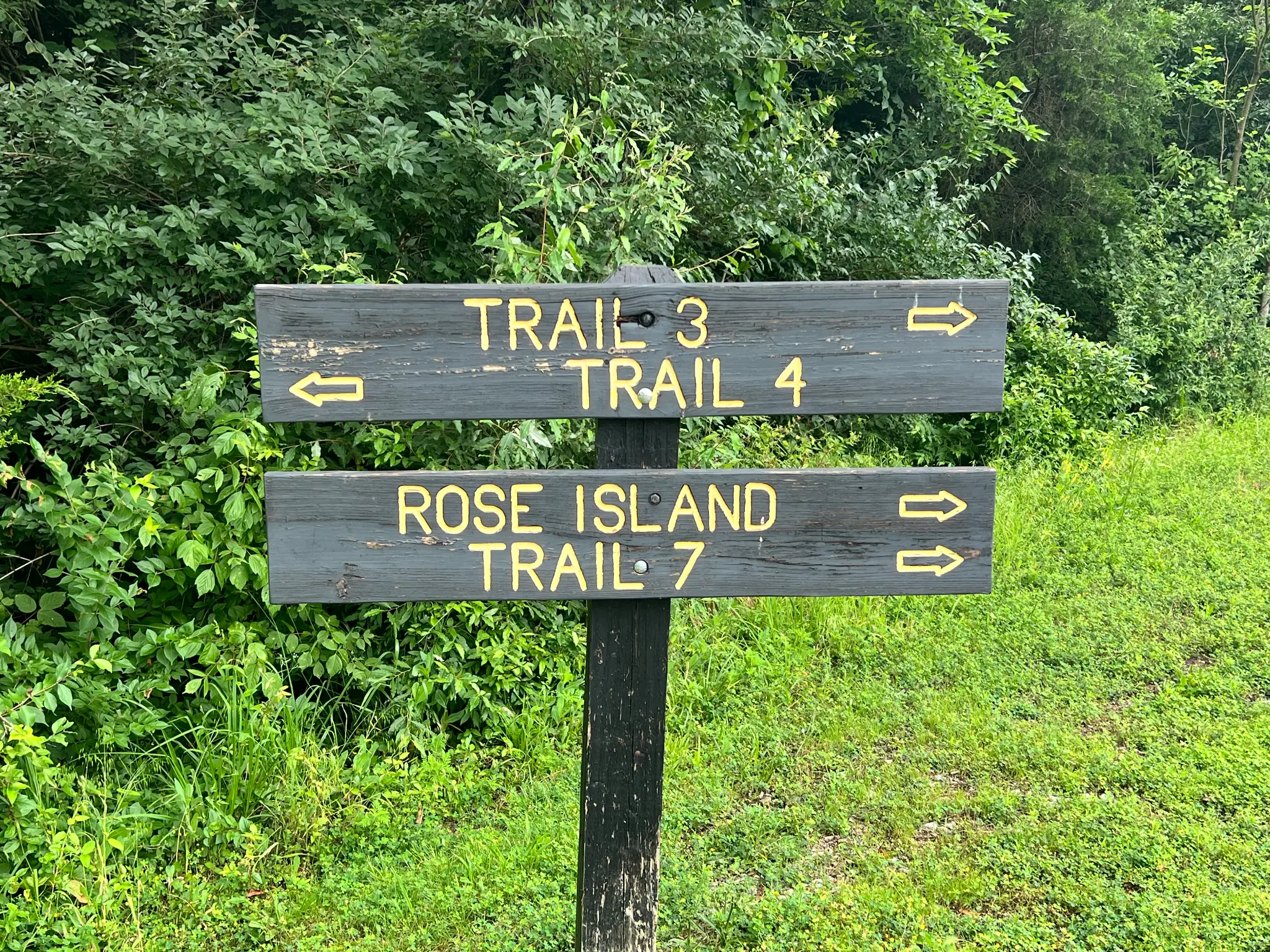
To reach the ruins, you'll start at the Trail 3 parking lot within Charlestown State Park. The path down is steep (seriously steep) on paved switchbacks descending toward Fourteen Mile Creek. The half-mile walk takes longer than you'd expect, and the return climb will remind you of every flight of stairs you've skipped lately. Bring water. Wear sturdy shoes. If you're pushing a stroller or have mobility concerns, call the park office at (812) 256-5600 in advance; they can arrange transportation to the trailhead.
At the bottom, the Portersville Bridge awaits. This iron truss bridge dates to 1912 and was relocated here in 2011 from Dubois and Daviess counties specifically to restore pedestrian access to Rose Island. Its wooden planks thrum beneath your feet as you cross.
On the far side, a replica of the original Rose Island sign greets you. From here, Trail 7 loops through the ruins in an easy, flat, 0.9-mile circuit on well-groomed gravel.
What will you see? More than you might expect, and perhaps less than you might hope. And each season offers a completely different look and experience.
The swimming pool is the most striking remnant: a ghost-like rectangle in the forest, its outline unmistakable, its ladders still curving upward from the gravel fill. Nearby, interpretive panels reproduce old advertisements and newspaper clippings. Three rusted arches from the Walkway of Roses still stand on their stone columns. A partially collapsed fountain sits where water once splashed. Concrete pilings from the original footbridge jut from the creek bank.
Throughout the site, poles mark where structures once stood, and something more affecting: blue rings near the tops, some as high as 20-25 feet, indicate the 1937 flood level. Standing beneath them, you understand what "ten feet of water" means. Especially when looking down the bank from where the hotel stood, and out to where the Ohio River still flows. The distance and height of the flood become stunning and almost unimaginable.
The park's most memorable feature may be the hand-crank audio boxes stationed along the trail. Turn the handle, and recordings play an historical narration, You'll the voices of people who visited Rose Island as children, sharing memories of the bear, the pool, the music. Full disclosure: the cranking mechanism and tinny playback threw me a bit at first, and at dusk, the feeling you get can be genuinely eerie…but not scary. Something to experience and remember.
An informative guided video tour of Rose Island, with park guide Scott Beavan, can be seen here: https://www.youtube.com/watch?v=1djpfWUaql4&t=2s
How to Visit Rose Island: Practical Guide and Tips
Location: Charlestown State Park, 12500 State Road 62, Charlestown, IN 47111. The park sits about eight miles east of I-65, roughly 20-30 minutes north of Louisville, Kentucky.
Hours: Open daily for day visits. Check the Indiana DNR website for seasonal hours and any closures.
Entrance Fee: $7 per vehicle for Indiana plates; $9 for out-of-state. (Verify current rates before visiting.)
The Hike: Plan for approximately 2-3 miles round-trip. Trail 3 descends steeply (0.6 miles, paved) to the Portersville Bridge. Trail 7, the Rose Island Loop, is an easy 0.9-mile gravel path through the ruins. The return climb on Trail 3 is the most strenuous part.
Difficulty: Moderate overall due to elevation change. The Rose Island Loop itself is easy once you're down. ADA assistance available by calling ahead.
Best Times: Spring and fall offer comfortable temperatures and manageable crowds. Autumn evenings provide the most atmospheric experience. Summer connects you to how visitors experienced the park, heat and all.
What to Bring: Water (no facilities at the trailhead), sturdy footwear, and time to linger. This isn't a site to rush through.
Current Note: The campground is closed for repairs through March 2026. Nearby camping available at Deam Lake SRA and Clifty Falls State Park.
Honest Assessment: If you're expecting dramatic, Instagram-worthy ruins, you may be disappointed. Much of what made Rose Island special is simply gone. But if you come prepared with historical context (and I'd recommend reading about it beforehand), the experience rewards patience. The combination of physical place and preserved memory creates something you won't find at a typical historical marker.
Further Reading: The Rose Island Story
The history of Rose Island deserves more than a single article can provide. For those who want to go deeper into the life of David Rose, the world of 1920s river resorts, the catastrophe of 1937, and the slow process of rediscovery, an upcoming book, The Rose Island Story offers a comprehensive account of this forgotten playground and the people who loved it.
But the best introduction remains the park itself.
Frequently Asked Questions
How do I get to Rose Island in Indiana?
Rose Island is located within Charlestown State Park, about eight miles east of I-65 on State Road 62. From the park entrance, drive to the Trail 3/4 parking lot, then hike down Trail 3 (steep, paved, 0.6 miles) to the Portersville Bridge, which leads to Rose Island.
What can you still see at Rose Island?
The most prominent remnants include the 1920s swimming pool (now filled with gravel but with original ladders intact), three rusted arches from the Walkway of Roses, stone columns, a partially collapsed fountain, and concrete pilings from the original footbridge. Interpretive signs and hand-crank audio boxes throughout the site explain what each area once contained.
Is Rose Island worth visiting?
Honestly, it depends on what you're looking for. If you want dramatic, photogenic ruins, you might be underwhelmed. But if you're interested in early 20th-century history, enjoy contemplative hikes, or want to stand in a place where you can feel what's been lost, Rose Island offers something genuinely unusual. The combination of physical remnants and preserved audio memories creates an experience that's hard to replicate elsewhere.
How hard is the Rose Island hike?
The Rose Island Loop trail itself (Trail 7) is easy: 0.9 miles of flat, well-groomed gravel. The challenge is getting there. Trail 3 descends steeply for 0.6 miles on paved switchbacks. Going down is manageable; the climb back up is genuinely strenuous, especially in summer heat. Total round-trip distance is about 1-3 miles. Bring water and budget extra time for the return.
Sources
- Indiana Department of Natural Resources, "Charlestown State Park," accessed 2025. https://www.in.gov/dnr/state-parks/parks-lakes/charlestown-state-park/
- Wikipedia, "Rose Island (amusement park)," last updated June 2025. https://en.wikipedia.org/wiki/Rose_Island_(amusement_park)
- Belle of Louisville Riverboats, "Belle of Louisville History," accessed 2025. https://www.belleoflouisville.org/belle-of-louisville/
- LEO Weekly, "Chase the ghosts of Rose Island, take a walk back in time," February 2018. https://www.leoweekly.com/2018/02/rose-island/
- IU Southeast Horizon, "What happened to the abandoned amusement park Rose Island?" accessed 2025. https://iushorizon.com/23025/features/what-happened-to-the-abandoned-amusement-park-rose-island/
Martin Jones is writing a historical novel about Rose Island, the forgotten amusement park on the Ohio River that operated from 1923 to 1937. The Rose Island Story will be published in 2026.